

In India, the term Trimurti is used in reference to the three faces of god. They are Brahma, Vishnu and Shiva. They are collectively known as the Trinity. Together they represent the oneness of the universe while retaining their distinctive nature and are known for their ability to grant boons. Hymns are chanted every day all over India, in temples and homes, and countless stories abound in their praise.
Here is the tale of How a Musician Became the Mouse and the Vehicle of Lord Ganesha
Krauncha was a celestial musician in Indra’s court. One day, he was running late for a performance and was walking rather hurriedly. Unfortunately, in his haste, he stepped on an old sage’s foot. The sage, whose name was Vamadeva, cursed Krauncha in a fit of fury and pain. “May you turn into a rodent that frantically scampers everywhere!’
Poor Krauncha was immediately transformed into a huge mountain rat.
Also Read: The Story and the Legend of the Elephant God Ganesha
As a rat he troubled many people, often creeping into farmer’s homes and eating their carefully stored grains or entering ashrams and destroying their food. When the people had had enough of his troublemaking, they called upon Ganesha to help them.
Ganesha heard their plea and threw his pasha, a noose, at the rat. But Krauncha managed to scamper away somehow.
‘I know you are quick and can creep into any place you want to because of your size and agility, but I am going to tie you up with this pasha so that you can’t trouble anyone,’ said Ganesha, determined. Adjusting the rope, he carefully aimed it at the rt and, this time, caught him. The noose was tightened and Krauncha could not escape.
Krauncha pleaded with Ganesha, ‘Lord, I understand my mistake and I will never trouble anyone again. Please allow me to be your vehicle so that whenever you are worshipped, I will also be revered.’
‘But will you be able to bear my weight?’ asked the pot-bellied god in amusement.
‘That will not be a problem. I will adjust my size according to yours.’
And that is how Krauncha the rat became Ganesha’s primary vehicle, enabling him to move quickly and get rid of obstacles for his devotees.
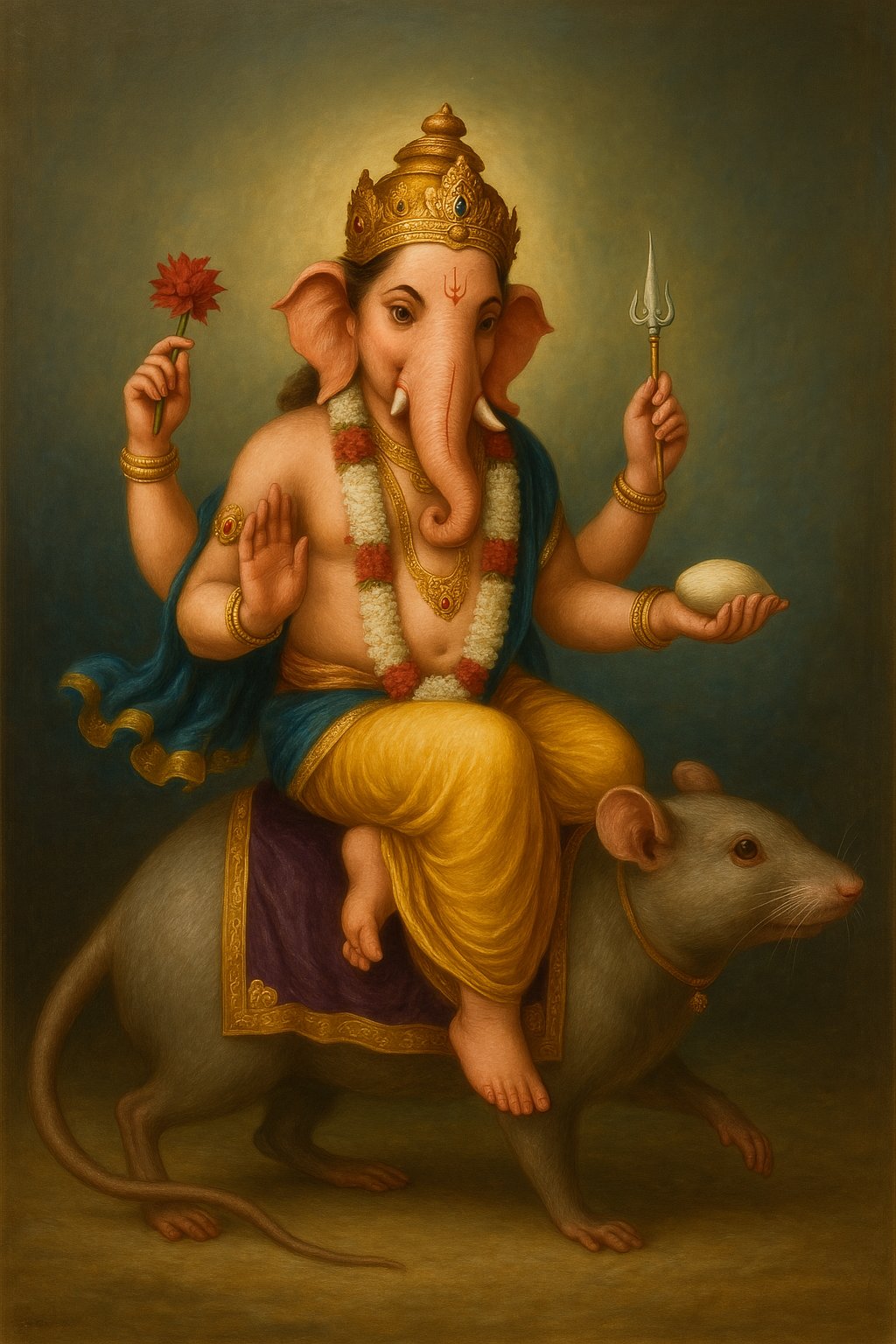
The Paradox of Power: Why Ganesha Rides a Tiny Mouse?
Lord Ganesha, revered as the “Remover of Obstacles” (Vighnaharta), embodies divine wisdom and power.
In ancient agricultural societies, rodents were a major threat, ravaging crops and stored grains, leading to hardship. By choosing a mouse as his vahana (vehicle), Ganesha symbolises mastery over these destructive forces, reinforcing his role as a protector. Additionally, the mouse represents Ganesha’s ability to reach every corner of existence, navigating even the tightest spaces and darkest paths, ensuring no obstacle remains untouched by his grace.
Another interpretation highlights the contrast between Ganesha’s colossal elephant head and his tiny mouse companion. The elephant signifies immense strength and wisdom, while the mouse mirrors the restless, erratic human mind, easily distracted and often destructive. Taming the mouse signifies the need for disciplined focus and spiritual control. When we begin a Sankalpa (new endeavour), we seek Ganesha’s guidance to steady our wandering thoughts and stay committed to our path, much like an elephant gently directs a restless mouse.
: ँ :
Thank you.
Do write what you thought of the story.
If today is the first time you have arrived on The Road To Nara, you are heartily welcome ~ Namaste
: ँ :
ROAD TO NARA is an Ethnographic Blog of History, Stories of Culture, Passion, Art, People, Rivers, Folk, Mysticism, Meditation, Mountains, Trees and Tantra Yoga Science of Ancient India and the Indigenous World to your mailbox.
Do subscribe to Nature: ROAD TO NARA

Subscribe to Nature
Type your email…
SUBSCRIBE

: ँ :
I will take this opportunity to introduce you to About me and importantly,
As a co-traveller, share my Ten Lessons I learnt from several years on the road, before you coarse on your own Road to Nara.
: ँ :
You might also like to know about My Little School Project.
If you wish to come over for a visit someday, that you must, you will be heartily welcome here
If you have anything to share, or feel like saying a hello, please feel free to write to me at lotusofnara@gmail.com
Instagram | X | Facebook
: ँ :
Gaṇeśa on a chariot drawn by his mount, the rat; Kangra or Guler, circa 1840

 ROAD TO NARA
I like the idea of Ganesha riding a mouse. It reminds me of Buddhism, where Manjushri rides a beast. The concept is similar, as Manjushri represents transcendent wisdom that has tamed the restless mind (beast).
LikeLike
We know a Computer has a “mouse” / “मूषक” that let’s the commands move onto the screen. The computer is called “संगणक” in Hindi. “संगणक” is verily गणेश.
So this is the perfect analogy.
गणेश rides over the “मूषक” / “मूषः” / “मूस” as is called in Bihar and U. P.
There is yet another analogy, but that I will reveal on another time.
LikeLike
Very interesting explanations!
LikeLike
That’s quite a point of view feat to make the rat a hero of this story.
LikeLike
Very interesting story.
LikeLike
Beautiful story and explanation. I didn’t know about this one.
LikeLiked by 1 person
Oh GC, sorry i missed your comments here. Thanks for your uplifting words.
LikeLiked by 1 person
Not an issue. How are you ? And congratulations!
LikeLiked by 1 person
I am very well dear GC. Right now preparing for an Special Teacher’s exam for tomorrow.
And congratulations for?
LikeLiked by 1 person
Interesting and insightful. Sometimes our holy anger can also have far reaching consequences.
LikeLike
That is true. Anger’s consequence actually is immediate and mostly never sweet 🙂
LikeLike
I enjoyed your story my friend!
LikeLiked by 1 person
Thanka Dwight.
LikeLiked by 1 person
You are welcome!
LikeLike
Nice sir, I’m glad I found and subscribed!
LikeLiked by 2 people
Makes me glad Nicholas. Somehow i could not visit your site as the link it tells me is broken.
LikeLike
This was such a delightful read! It’s fascinating how many of our myths use animals not only as companions but as symbols of qualities within us. Sometimes I wonder if that’s why every deity has a vahana: a way of showing that even instincts and fears can be carried, not discarded. I recently found myself reflecting on this while writing about why gods need vehicles at all, and your story adds such a rich layer to that thought. Thank you for sharing this! Happy to have found your blog!
LikeLiked by 2 people
Hello Nehal, lovely to read from you too. I am certain our ancestors saw through time the earliest than anyone on Earth then and gave us these Keys. Today’s life is that chronicle and we have all these keys available to us as our most valuable inheritance to make use of in our favour. To somehow bring them in use the way we can, perception differs but symbolism has been the key they are still alive. Tales so rich that we still keep deciphering them.
Happy to have you here. Thank you again.
LikeLiked by 1 person
Thank you so much for this beautiful response! I completely agree! Our myths really are timeless keys, guiding us across ages in ways we’re still learning to unlock. I love how you put it: “symbolism has been the key they are still alive.” It’s incredible how stories told millennia ago still breathe through our lives today. Truly grateful to connect with someone who sees their depth this way. 🙏✨
LikeLike