

Folktales are Oral stories that are passed down by the elders to the younger generation. For centuries, folktales have been a crucial medium for preserving cultural traditions and teaching the youth to understand the world around them.
A folktale in Malwi, a Rajasthani Hindi dialect of Madhya Pradesh: Sona and Rupa
One evening a prince was returning home on his black mare after a hunt, and took the mare to drink from a stream. As he watched it drink, he saw, along with his own and his mare’s reflection, several strands of gold and silver hair floating on the water. Obviously, lovely women with hair of gold and hair of silver had bathed somewhere nearby, upstream. He bent down and picked up the hair. The more he looked at it, the more he thought of the beauty of women with such hair and was infatuated with the images in his head. He tucked the hair into the folds of his turban, mounted his mare, and went home to his palace.
It was time for dinner, but the prince did not appear. Everyone looked for him, but he was nowhere to be found. The queen mother sent servants into every room and to every corner. One of the servant woman went into the storeroom to fetch some sugar. The prince was lying there, face down, on the floor. She was about to cry out when the prince said to her, ‘Don’t tell anyone or you’ll die.’ But as they say, a woman and the wind cannot hold a secret. She whispered it to the queen, and the queen came to the storeroom loudly scolding her servant: ‘Why haven’t you swept this place, you lazybones?’ Then, as if her eyes had just lighted on the prince on the floor, she cried out, ‘Look who’s here! O son, what’s the matter? Why are you lying in the dust? What has made you so miserable? If anyone has insulted you, I will have his tongue cut out. If anyone has raised his hand against you, I will have his hand chopped off. Tell me what’s troubling you. And get up, for god’s sake.’
The prince sat up, took out the gold and silver hair from his turban, and holding it up to the queen, said, ‘I want to marry the girls who have such gold and silver for hair.’
The queen said, That’s nothing. We will find those girls, wherever they are.’
‘But I must have just those girls whose hair matches this.’
‘Surely, my son, you will have them, ‘said the queen. But she felt dizzy and stumbled as she walked out of the storeroom.
Messengers were dispatched all over the capital. The town crier called out in the streets that all the young women of the city should walk next morning in the palace yard with their heads uncovered.
Next morning, there was a long parade of women before the palace. The prince watched them for hours, but he couldn’t see any woman whose hair matched what he had in his hand.
Suddenly his eyes fell on two girls, with hair of gold and hair of silver, sitting in the courtyard of the women’s quarters of the palace. He called out to his mother the queen, and pointed them out to her. The queen was stunned but somehow found words to say, O God! They are your sisters, Sona and Rupa.’
The prince’s face fell. But he wouldn’t give up his wish. He said, ‘Marry them I must, whosoever they are. If I can’t, I will leave the country.’
The King came down and tried to talk him out of it. Relatives, elders, and ministers talked to him. The queen begged him with folded hands to change his mind. But the prince wanted what he wanted.
So they made arrangements for the wedding. A grand pavilion was raised on the green bamboo poles with a vast canopy of silk and canvas. The news travelled from ear to mouth and from mouth to ear till it reached Sona and Rupa. They were speechless with horror. Their faces went dark and their eyes filled with tears.
Now, on the bank of the river where they bathed grew a sandalwood tree that the two princesses had watered and tended since they were small. It had grown with them. It was now tall and full grown.
On the wedding day, Sona and Rupa climbed the sandalwood tree and hid in its branches. As the time for the rites grew near, the palace servants looked for them and found them sitting on a high branch. The servants begged them to get down, but they wouldn’t. The king himself came to the tree and said:
Come down, come down,
My daughters, Sona and Rupa.
The wedding hour has come.
Sona and Rupa said:
O Father, we called you father.
How can we call you father-in-law?
Higher, higher, O sandal wood tree!
And the tree grew taller and taller and took them higher.
The whole family gathered there and called them, but they wouldn’t come down. With each call, the tree grew taller and took them higher still. Finally, the prince himself came there and called them out:
Come down, come down,
My sisters, Sona and Rupa.
Our wedding hour is near.
But they replied:
O Brother, we called you Brother.
How can we call you Husband now?
Higher, higher still, O Sandal tree!
All at once, clouds gathered. The skies thundered. The tree suddenly split open and took them inside. Before the family’s eyes, Sona and Rupa vanished deep within the tree.
: ँ :
Please, do share what you think about the Story?
Thank you
If today is the first time you have arrived on The Road to Nara, you are heartily welcome ~ Namaste
ROAD TO NARA is an Ethnographic Blog of History, Stories of Culture, Passion, Art, People, Rivers, Folk, Mysticism, Meditation, Mountains, Trees and Tantra Yoga Science of Ancient India and the Indigenous World to your mailbox.
Do subscribe to Nature: ROAD TO NARA

Subscribe to Nature

: ँ :
I will take this opportunity to introduce you to About me and importantly
As a co-traveller, will take you through the Ten Lessons I learnt from several years on the road, before you coarse on your own Road to Nara.
: ँ :
You might also like to know about My Little School Project.
If you wish to come over for a visit someday, that you must, you will be heartily welcome here
: ँ :
If you have anything to share, or feel like saying a hello, please feel free to write to me at lotusofnara@gmail.com
To follow my walks through the rural Indian Subcontinent, find me at :
Instagram | X | Facebook
: ँ :
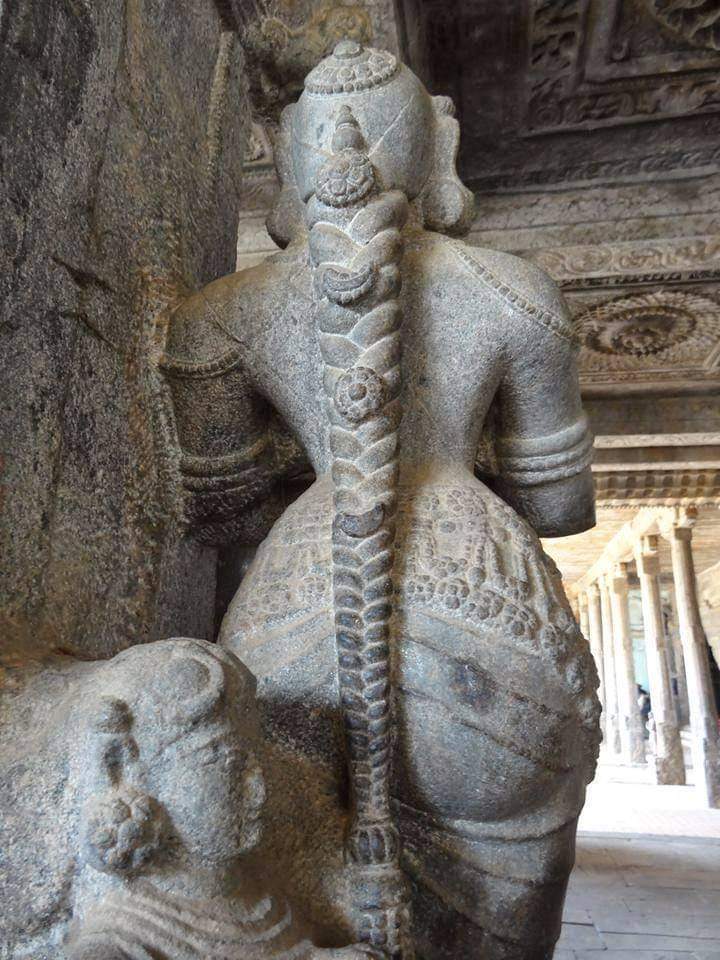
Image Credit: alaka-avali (Sanskrit): hair arrangement in spiral locks. dhammilla (Sanskrit): hair bun. The classical Gupta era style, with curls and hair bun. The curls gradually disappeared from Indian art after the Gupta era ended. At the large Vishnu temple, Janjgir, Chhattisgarh.

 ROAD TO NARA
An very interesting and instructive story pointing out that when society ignores moral and ethical code of conduct, the destruction befalls on the whole society and no one then can save it.
LikeLiked by 1 person
What a beautifully told folktale! The story of Sona and Rupa is rich with cultural depth, symbolism, and emotion. The imagery of the golden and silver hair, the sandalwood tree, and the sisters’ ultimate transcendence is both haunting and poetic. It’s a powerful tale of love, defiance, and familial bonds, leaving a lasting impression. Thank you for sharing this gem!
LikeLiked by 1 person
An interesting story! I love the scent of sandalwood.
LikeLiked by 1 person
That is a fascinating story. It happens all the time when parents bend to the will of their children in spite of knowing that it is wrong. Addiction of any form is part of human life, now we are seeing very small children getting addicted to it. Parents are responsible for it. Thank you for this story.
LikeLiked by 2 people
Absolutely Lakshmi Ji. This story says a lot about things that our society or the world at large went through. It is as fascinating a tale as it is sad. Yet on many levels, True.
LikeLiked by 2 people
I do not know a great deal about India, or Indian culture, other than what I researched trying to understand the photographs and my father’s time in India during World War II. (Which by the way, was a wonderful journey on my part to learn about where he was, and the important role that India played.) But when you ask, what do you think about the story, I can say what I think about your story. I am thinking of so many men in positions of power and authority, who think they are entitled to have whatever they want if they desire it. I am thinking of how often women were powerless to respond to such a demand, and that even now it remains so for many women, and certainly for young girls. The ending sounds magical, because I doubt other women could climb a tree and command it to grow and it yield a sanctuary for them. Perhaps that is the point, that in presenting the two sisters survival from having to marry their own brother, they saved themselves, and the story inspires other young women not to yield to power when the demands of power are immoral. That is often the moral of folklore–to use the stories to teach a lesson.
And in that case, I think it presents a moral lesson, a lesson in courage, and a resolute commitment to what is right that is relevant more than ever today.
LikeLiked by 1 person
What a beautiful heartfelt comment Suza, I.will get back to it again and write to you.
LikeLiked by 1 person
Thank you, Narayan, and I look forward to hearing your response. Thinking about thinking is important.
LikeLiked by 1 person
You were on point, dear Suza, as much this story was. Because I know when i was writing it, it gave me an uncanny feeling. I wasn’t even comfortable myself to absorb it. Not in the way that man asked for it, but in the manner it was resisted.
It absolutely takes us much deeper in understanding the times and situations that were and still are prevalent in many societies/communities.
Thank you for evoking these feelings with your comment.
LikeLike
Also, please plan a short visit to India to at least those places your father spoke/talked or wrote about. I will be more than happy to assist.
Thank you again.
LikeLike
That is very kind of you. I would love to visit, but my days of traveling that far are behind me, not in front of me.
LikeLiked by 1 person
Aah I see Suza, it would have been nice to come and visit a country your father spoke or even wrote about once and that too which has been a spritual.center for the world since time immemorial..But however, it is wonderful to have this conversation with you.
Please be around.
LikeLike
Thank you, Nara. I truly would love to come and visit and be able to track my father’s journey from Los Angeles to Bombay (now Mumbai), across country to Tezpur and Jorhat. Because of his photographs, I was able to look up many of the places he was and learn more. From there, he went to China and was in Kunming, Luichow, and Shanghai from Sept. 1945 until May 1946. I have some of Dad’s letters he wrote from India and China, and many photographs. Sometimes, we just cannot do the things that are our heart’s desire, but I appreciate that I have been able to learn as much as I have.
LikeLike
Folktales are such a rich source of learning about the culture, the mores of the time and place of the setting. Other than the regular ones about rich and poor and such, there are such off-beat ones too, which come both as a surprise and as a revelation of our society of yore. I agree in toto with Suzassippi’s comment about powerful and arrogant men and helpless women.
LikeLiked by 1 person
This actually was a very different folk tale that one doesn’t hear in everyday life. And it leaves one thinking, for more unsaid reasons than known. Also as you pointed it out, tells so much of the society and how powerful and arrogant men behaved rather still do.
Thank you, Zephyr.
LikeLike
Beautifully presented. Interesting folk tale.
LikeLiked by 1 person
This folklore was unlike folk tales you would hear. And says a lot quietly. Thank you, Kritika.
LikeLiked by 1 person
I have never heard this one. Thank you for weaving the lores in your words. 🙂
LikeLiked by 1 person
Thanks You Kritika, I am learning myself and I am enjoying as much as I slowly write/research one after other. It’s my pleasure.
Thank you again.
LikeLiked by 1 person
An honor 🙂
LikeLiked by 1 person
Lovely! I learn so much from your blog. Interesting folk tale.
LikeLiked by 1 person
Very Interesting these Tales are Certainly. Making me understand something deeper too Vanya.
And thanks you for some much needed appreciation. Made my day 🙂
LikeLiked by 1 person
1. I think the question mark after the please statement ( asking for feedback ) is not appropriate.
2. In my high school, which was a convent, we all used to repeat a pledge every morning “India is our country, all Indians are our brothers and sisters…”
3. If pledges really mean anything: most of these people who graduated from such schools married their brothers and sisters. Find by me. I didn’t.
4. In the myth of Eden, Adam and Eve: Eve or Howwa was literally daughter of Adam created out of his flesh. Supernatural TV series has a nice story about a God and his sister Darkness.
LikeLike
Fine*(3) not find. Flesh and (4) bones*
LikeLike
Appreciated
LikeLike
Thanks Swami !!
LikeLiked by 1 person
We also have very famous ancient legends, particularly in the Greek and Roman lineage, about women for whom the Divine answers prayers for protection from ravishment by turning them into plants or trees.
LikeLike
Ana Ji how are you dear friend, Greek and Roman, go ages back and yes can’t even imagine how women must have found their ways to reach the divine, for it wasn’t a kind and lawful world back then. Power and might was the only justice, even today somehow but atleast it’s not arbitrary.
Thank you and please share What refreshing things you are upto these days?
LikeLiked by 1 person
Nothing very refreshing, my friend. Still imprisoned in my van, unable to leave it safely, and tormented like a caged bear within it. Still not getting notifications for your posts, so I will check in from time to time.
LikeLike
Indonesian culture always interested me. Thanks for the support you are writing in culture. I like Aztec Knod writing. I adore it.
LikeLiked by 3 people
Hi Claudio, lovely to have your words here. Would have loved to read your blog but somehow it isn’t linking back to your site.
As for Indonesian culture, I am certain you find it interesting as they are still practising their ancient hindu roots, with their center in Bali.
LikeLike
I do not know about Aztec knod writing. Please find time to share something that introduces me to it. Thanks much for this.
LikeLike
I deleted because it got out of hand in respect to you and your manners I am left in awe by your answer. Well if you would use the same modus operandi as in your blog it will be easy to get in touch with aztecs. It took me some time to figure out in Switzerland we are helvet derived from celtics. There are feasts where we throw axes at wooden plates and drink moon brewed beer out of clay mugs and enviro the old styles. We helvets get along with our bears and wolves and seize nature. The feasts are called highlander gatherings and this is on of my roots. We explained us the world by a tree. The world tree. You know this MRna vaccines C and H and Oxygen and ans grew on trees too. Then there are the three old sisters who do the destiny. One makes by twerning the wooll and one spins the rope by the spinning wheel and the third does the knitting of the destiny. Than there’s Thor and Loki. I read the germanian saga in German by j.wHohlbein. It was the fuel for my endaber to pass beneath Oath comarades. “Eidgenossen”. They invented the constitution in 1291 and thought they were superior and applied value to the world tree and the three sisters. But think of Midgard as of a model rather than faith.
LikeLiked by 1 person
This is Linn at Bötzberg, Aargau, Switzerland: https://www.linnerlinde.ch
I once went there on an excursion in elementary school and by my pals I could surround the lime tree as one by holding hans. We were eleven children and one grown up and it was close that we could hug this lime. If we had been one less it would not have worked. This tree is older than 800 years and it has a diameter of 3 meters so its circle is eleven meters. Limes are well used to heal all kinds of diseases like the pestilence. Right now I’m in a distance of maybe 8 km to this tree and feel calm and strong.
LikeLike