
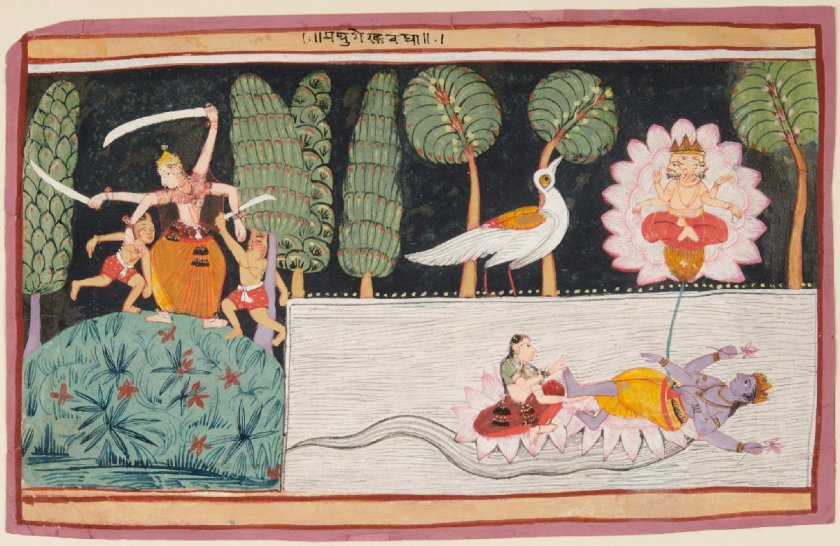
Madhu and Kaitabha both originated from the earwax within the deity Vishnu‘s ears, while he was in a meditative state of yoganidra. From his navel, a lotus sprouted, upon which Brahma, the creator, sat contemplating the creation of the cosmos. Two dewdrops of water upon the lotus were created by Vishnu. One drop was as sweet as honey, and from that drop emerged Madhu, imbued with the attribute of tamas (darkness). The other drop was hard, and from it was born Kaiṭabha, imbued with the attribute of rajas (activity). For many years both fed on the Ocean water when one day they started hearing incantations day and night. Not knowing where to go and where the sounds came from, they surrendered and started chanting themselves.
They began meditating on the glorious force while not eating or drinking but constantly chanting the mantra they had heard before. Their penance lasted a thousand years when the mother Shakti finally appeared before them and said, I am very pleased with your devotion. Ask me whatever you wish for and it will be granted.
Also Read: The Origin of Five Heads of Brahma and a Boon Gone Wrong
Awestruck, they said, “Allow us to die only at a time of our choosing, let us not die otherwise.”
Devi smiled, ‘So be it.’ You will practically be immortal and your strength will increase thousand fold. The suras or the asuras shall not be able to defeat you, and till you decide of your own free will, you shall live.

Like all other power hungry demons, the two brothers soon became evil and insufferable. They seized whatever they wanted and killed whoever tried to stop them. One day they went to meet Brahma. The god was sitting high atop his lotus and was busy sculpting his creations.
The two brothers were irked to see him so high up. ‘Come down, old man!’ They said to Brahma. ‘Only people with strength and mental fortitude such as ourselves should sit so high. If you want to stay up there, fight and defeat us first. Come down now! We are ready whenever you are!’
Brahma knew he could not fight these warriors, who had been strengthened by a boon from the primeval Devi. He thought of Lord Vishnu, that only he can save me from this calamity. But he is in deep sleep and should be awakened immediately.
He fled to the abode of the lord. The two brothers seeing him run were overjoyed to have humiliated the eternal creator. Brahma in the meantime, kept running without looking back even once, until he reached Vishnu and related everything that had happened. ‘Lord, if these demons could make me run from my abode, imagine how they must be looting and killing other beings. You must do something and kill them!’
As Vishnu pondered over the situation, Madhu and Kaitabha reached Vaikuntha in search of Brahma. Beholding him there, they said, “why have you run away to this place? Are you trying to save your life seeking asylum from this person? Fight us. But Lord Vishnu interrupted them and said, forget him, If you have faith in your own strength, then fight me. They smirked and said, ‘O great Vishnu, how can you protect another when you yourself are so weak compared to us?’
Without waiting for an answer, the demons looked around Vaikuntha and liked what they saw. ‘Why don’t you give your abode to us?’ They demanded. ‘We are more suitable inhabitants. But come, we will allow you to try to defeat us first.’
‘Then let us fight, agreed Vishnu placidly.
The fight began. It was a wrestling match to behold. When Madhu got tired, Kaitabha would engage. It is said that this great battle went on for five thousand years. The lord was surprised at his inability to destroy these demons. Vishnu reached out to Primeval Devi telepathically through his mind. ‘You gave these two asuras such power, so you must be accountable for their actions. I need your help.’
The goddess responded, “O Vishnu, please continue your battle, I have heard your prayer. These Asuras must be overcome by trickery. An illusion is a right weapon to use against these warriors. I shall cast my evil eye on them, depriving them of reason. I will enter the asuras minds and enable you to trick them. It will be easy for you to kill them then.”
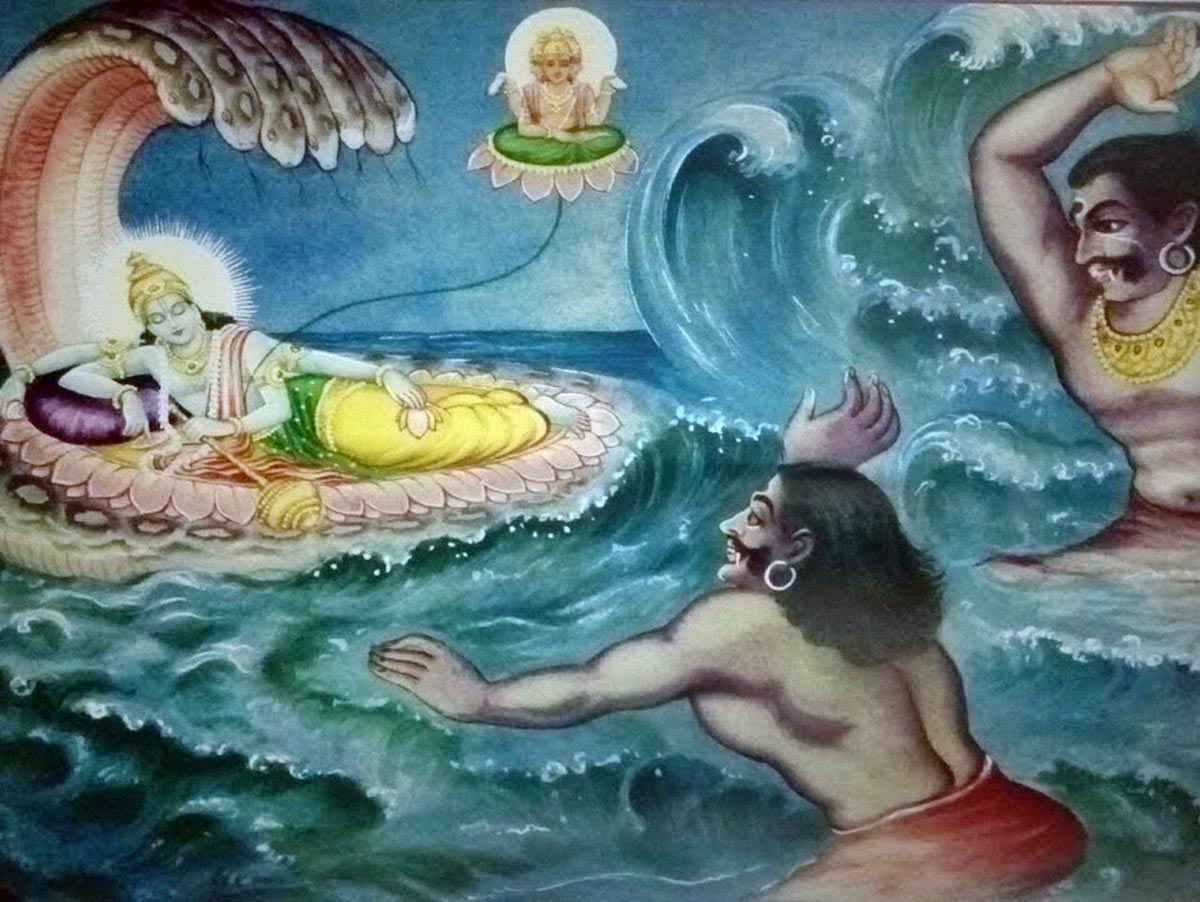
The fight went on for sometime, the two asura warriors wanted to rest. They asked Vishnu, ‘would you like to take a break and rest before we continue?’
Of course we must rest. We must respect each other as warriors.
While they were resting, Vishnu observed that the concentration of his foes was wavering, he addressed them in a loud voice and said, “I have been very much pleased by the skill you two have displayed. Till date, I have not come across a single person who could stand up to me in concept. In recognition of your bravery, I shall grant you a boon. Ask, and it shall be yours.”
Befuddled by the Devi’s gaze, the demons laughed at the proposal. In a tone of derision, they said, we are winning this battle. It is for victors to grant a boon to the vanquished. We are more powerful than you. What boon can you grant us? Instead, we shall grant you a boon. Ask, and it shall be yours.
The Demons were quite sure that Vishnu’s would ask for a truce. But Vishnu realised that this must be Devi’s doing. He said, ‘You both are honourable warriors and I am thankful for the boon that you have offered. I desire that both of you perish by my hand.’
The deed was done and the goddess vanished from the minds of the asuras. Madhu and Kaitabha realised their folly, but it was too late. A word of honour must be kept and, reluctantly, they agreed to die.
Despite his victory, Vishnu regretted the result of his trickery. So he said to them, ‘You may ask me for anything except your lives, and I will do my best to fulfil it.’
They said, ‘O lord! After our death, we wish for a temple each to be built in our names. Since we are devotees of goddess Parvati, we would like an Eshwaralinga in each temple too.’
Vishnu nodded, and then executed them with his Sudarshan Chakra.
Later, Madhukeshwara temple was built on the very spot where the asuras had perished, on the banks of River Varada, and Kaitabheshwara Temple was erected nearby, with a linga in each.


The temple you see today is a result of a number of modifications that have happened during the times of Chalukyas and Hoysalas, ruled after Kadambas.
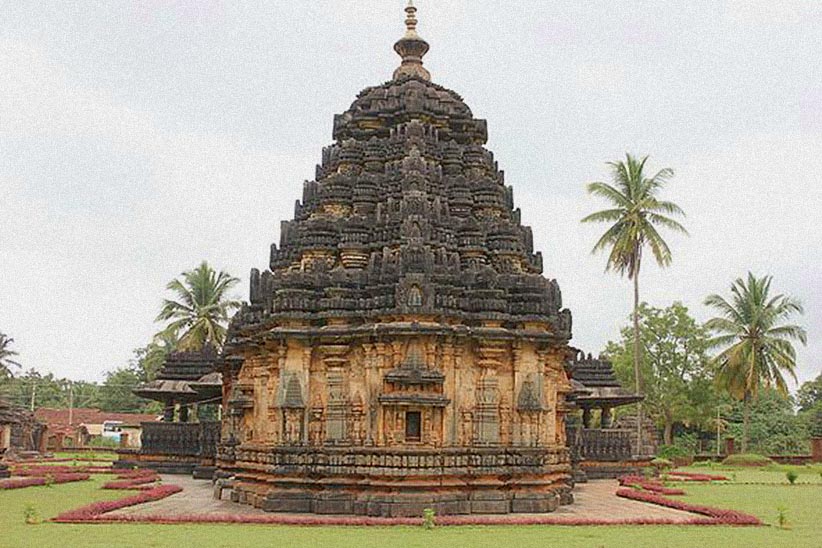

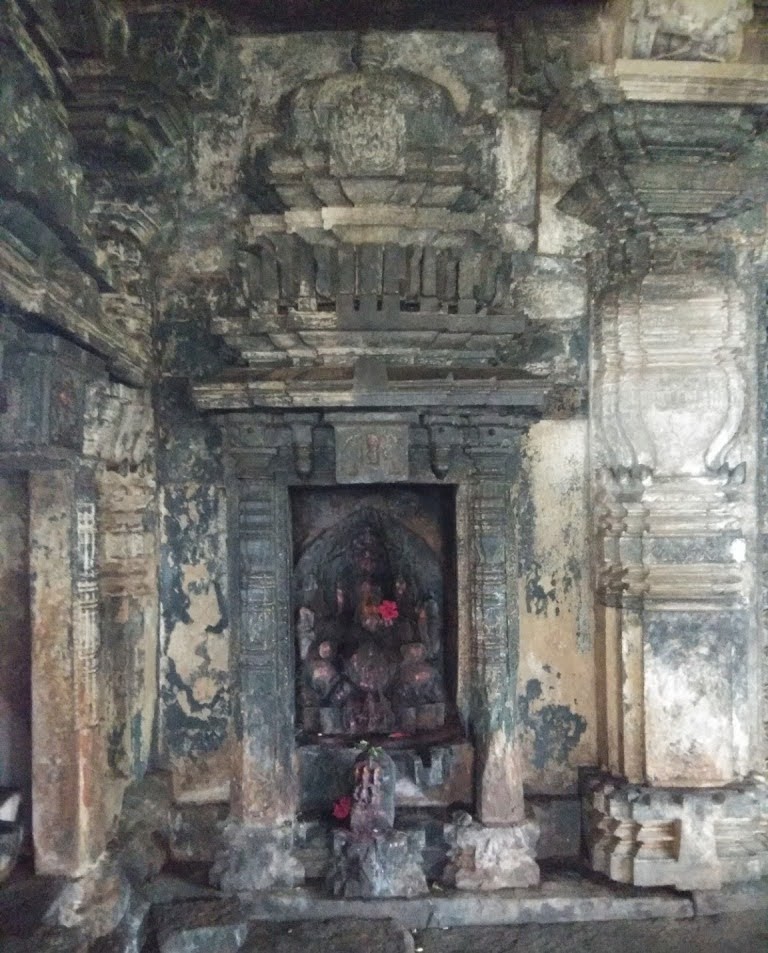
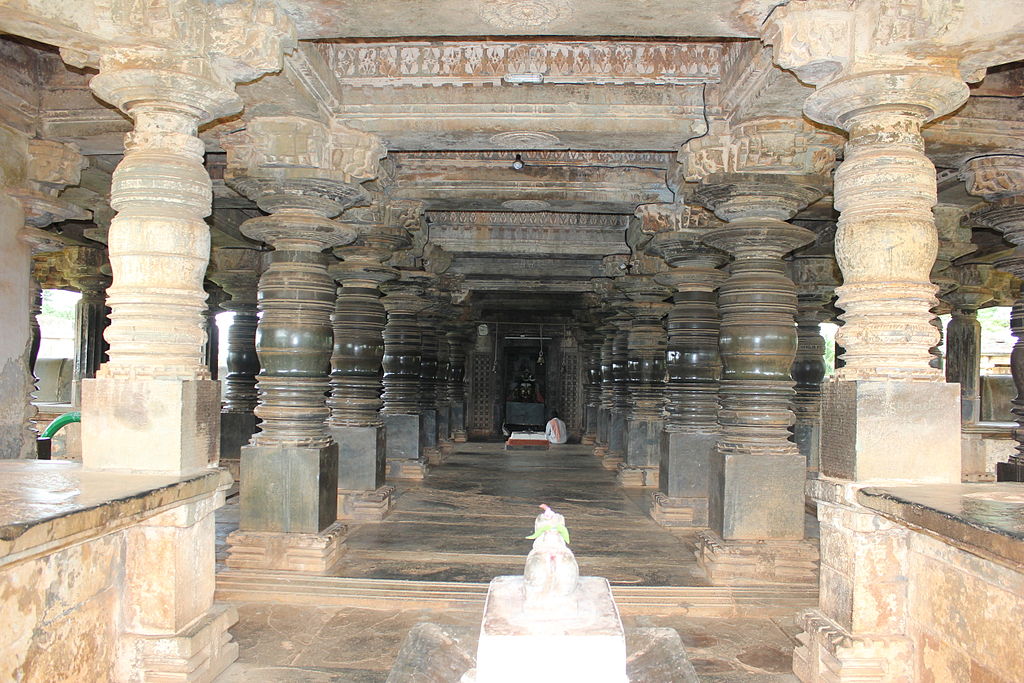
The Kaitabheshvara temple (also spelt Kaitabhesvara or Kaitabheshwara, known also as Kotisvara) is located in the town of Kubatur (also spelt Kubattur or Kuppattur, and called Kuntalanagara or Kotipura in ancient inscriptions), near Anavatti in the Shimoga district of Karnataka state, India. The temple was constructed during the reign of Hoysala King Vinayaditya around 1100 AD. The Hoysala ruling family was during this time a powerful feudatory of the imperial Western Chalukya Empire ruled by King Vikramaditya VI. According to the Archaeological Survey of India, the architectural signature of the temple is mainly “Chalukyan”. Art historian Adam Hardy classifies the style involved in the construction of the temple as “Later Chalukya, non mainstream, far end of spectrum”. The building material used is soapstone.
The temple is protected as a monument of national importance by the Archaeological Survey of India.
Today the two temples are in Karnataka and approximately twenty kilometres apart- one is in Banavasi and the other is in Kotepura.
: ँ :
Thank you.
Do Share what you thought of the story?
If today is the first time you have arrived on The Road To Nara, you are heartily welcome ~ Namaste
: ँ :
ROAD TO NARA is an Ethnographic Blog of History, Stories of Culture, Passion, Art, People, Rivers, Folk, Mysticism, Meditation, Mountains, Trees and Tantra Yoga Science of Ancient India and the Indigenous World to your mailbox.
Do subscribe to Nature: ROAD TO NARA

Subscribe to Nature
Type your email…
SUBSCRIBE

: ँ :
I will take this opportunity to introduce you to About me and importantly,
As a co-traveller, share my Ten Lessons I learnt from several years on the road, before you coarse on your own Road to Nara.
: ँ :
You might also like to know about My Little School Project.
If you wish to come over for a visit someday, that you must, you will be heartily welcome here
If you have anything to share, or feel like saying a hello, please feel free to write to me at lotusofnara@gmail.com
Instagram | X | Facebook
: ँ :
All images from Internet. Kindly Comment for Credit.

 ROAD TO NARA
Narayan, thank you for your wonderful telling of this fascinating legend. 🙏
LikeLike
Dear Ashley, thank you for this lovely comment.
LikeLiked by 1 person
Thank you. When we go that side, we will definitely see these two temples. It is fascinating to read the history of our temples.
LikeLike
Please do. I think its a great time to re-visit our history and see our own civilisation with a new understanding and vision.
LikeLiked by 1 person
The story of the dealings of the two inhuman evils, Madhu and Kaitabha in
Narayan today’s essay reads like a thriller with many twists and turns to keep readers on tenterhooks! It is an important reading because Narayan’s fascinating details which are expertly written show that Hindi mythology is not only one of the oldest in the world but also far more complex and colorful than ancient Egyptian or Greek ones. The high degree of imagination is even more impressive as Hindi mythology was not the work of one person. According to a legend Brahma, the creator of the universe, was one we can be thankful for our great pleasure of reading not only the stories in Hindi mythology but as they mirror the mystery of the universe bringing us to understand better the essence of India.
Narayan’s divinely inspired presentation of many stunning temple pictures
is unmissable! Thank you.
Joanna
LikeLiked by 1 person
Thanks Joanna, for adding some intricate details on how myth and ancient history of India is interlinked.
Here, I will be trying to collect some of those tales as a collection.
Thank you dear Joanna for this important comment.
LikeLike
You are welcome, Narayan.
Joanna
LikeLike
I enjoyed your telling of this complicated legend. I have the impression that Hindu legends are all fairly complicated? I remember going to Indian films when I was a kid. I didn’t understand a word but it was very dramatic!
LikeLiked by 1 person
Caro, India since the time immemorial has been known as the land of storytellers. There are so many legends that every state have their own, in their own language dipped in culture and landscape. Topped with stories of Indian deities that runs through the geography of the scape.
Well, dramatic, overflowing with emotions, colours, dance is the flavour of most Indian films. But there has been a layer of Indian Regional cinema not known but presents magnetic stuff and last some years some films have even reached to the Oscars.
Here, trying to conserve some complicated tales here Caro, so you may expect a lot more interesting tales in future.
Thanks for writing Caro.
LikeLiked by 1 person
I will look forward to them!
LikeLike
“Like all other power hungry demons, the two brothers soon became evil and insufferable.” words to live by. Wonderful story and very wise (to me).
LikeLike
🙂 I am smiling. Thanks Martha.
LikeLiked by 1 person
The pictures really bring the story to life!
LikeLike
Yes Vanya, they do. Carry us on the verge of it all happening in some era, some plane, some part of this vast universe.
Thanks for writing in kind.
LikeLiked by 1 person
Thank you for this wonderful mythical story 💖
LikeLike
Thank you Dr Venky.
LikeLiked by 1 person
It was a fascinating tale written with the endearing story telling like our etenally gifted grandmothers. The myriad photos put the whole fairytale in real-time perspective. Thank you, it was beautiful strolling in your blog Nara.
LikeLike
Thank you much Rashmi, losing their charm if only told as it came to us can put newer generation and even us, off. One thing to realize about Indian legendary tales is that through ages people have lived them, to a point that across our geography there are evidences to all those tales.
Thank you for writing in Kind Rashmi.
LikeLike
What a beautifully told and captivating legend, Narayan! ❤ The photos are lovely. ❤ Thank you for sharing this post. Hope all is well with you.
LikeLike
Cheryl, thank you for an uplifting comment.
Just trying to collect some old tales for coming times here, some times boring but they still evoke a lost sense of fantasy and imagination that legends carry.
Yes, with grace things are well Cheryl. Thank you.
LikeLiked by 1 person
I find a striking moral parallel in the legend of Madhu Kaitabha to the expelling of Adam and Eve from the garden lest they eat of the fruit of the tree of life – they would have been doomed to the conversion of evil and the state being perpetual. Interesting contemplation.
LikeLike
Hey, thanks Gerry, legendary stories have a lot to in common across regions to serve their people morally right. Thanks for writing.
LikeLiked by 2 people
Thank you for sharing this legend, Narayan. The more you learn about puranic tales, the more your realise you have so much to still listen to and know about. One lifetime is surely less for it all!
LikeLiked by 1 person
Accept my apologies for writing this late dear Cyberma. I have been pretty inconsistent these past months in keeping up with the site. And you are absolutely right, the more I learn of our puranic stories, more I want to get them right. There are sub-divisions of divisions and one story leading to character that lead to many others just like how we live and know life in daily ways. These are important tales and the ones who know them shall make up to be the greatest storyteller as anyways we Indians are nothing else but actually are greatest storytellers. It’s important to continue and practice this well.
LikeLiked by 1 person
What a very interesting story! Amazing work on those temples.
LikeLike
Pingback: The Choice Of Death: The Legend Of Madhu Kaitabha | Vinayvaidya's Blog
I enjoyed this story very much and the temples are very impressive. Thank you for sharing.
LikeLiked by 1 person
Welcome Karima, thanks for sharing your thoughts.
LikeLike