
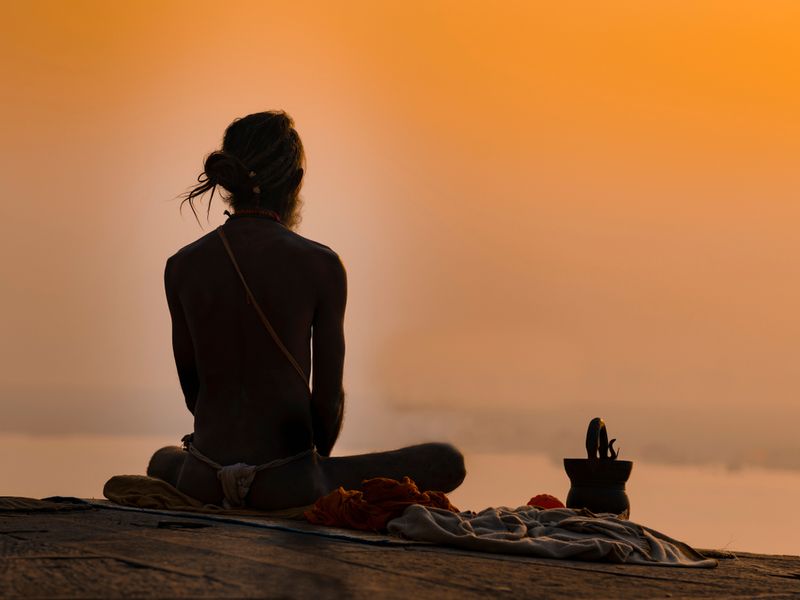
In India, the term Trimurti is used in reference to the three faces of god. They are Brahma, Vishnu and Shiva. They are collectively known as the Trinity. Together they represent the oneness of the universe while retaining their distinctive nature and are known for their ability to grant boons. Hymns are chanted every day all over India, in temples and homes, and countless stories abound in their praise.
Here is the tale of Sati, the wife of Shiva
King Daksha was one of the sons of Lord Brahma. Daksha had many daughters. Twenty-seven of them were married to the handsome moon god, Chandra and among his remaining daughters, Dakshayani was married to Shiva.
Daksha was not at all happy with Dakshayani’s choice. Shiva spent most of his time either on Mount Kailash in the freezing Himalayas or in Cremation grounds. To make matters worse, he looked positively dreadful with his long, dark, matted locks and that snake wrapped around his neck like a garland. Daksha felt that his beautiful daughter deserved a better husband. But Dakshayani, who was also known as Rudrani, was very happy with Shiva and enjoyed her time with him no matter where they were.
One day, Daksha decided to perform a grand Yagna. He invited all his daughters and his sons-in-law, as well as many other relatives and friends to participate in the event.
One day, Daksha decided to perform a grand Yagna. He invited all his daughters and his sons-in-law, as well as many other relatives and friends to participate in the event.
On the day of yagna, as soon as Daksha entered the place, everyone stood up to welcome him. All except Brahma and Shiva.
Daksha was livid. God or not. Shiva was his son-in-law. And by not standing up at his arrival, Shiva had insulted Daksha- at least that’s how the King perceived it.
A few months later, Daksha held another grand yagna. But this timem he didn’t invite Dakshayani and Shiva. When Dakshayani heard that all her sisters were visiting her father’s house, she said to Shiva, ‘I want to go to my father’s house for the yagna. Will you come with me?’
Shiva smiled and replied, ‘You shouldn’t go without an invitation, even if it is your father’s home.’
‘A daughter doesn’t need an invitation to visit her parents,’ she retorted.
‘All right, but he warned that your father may use strong words against me. I know how loyal and kind you are, and I am afraid that it may be hard for you to listen to him. I hope you will be careful. I won’t accompany you, dear wife, but my blessings are with you.’
Dakshayani quickly collected a few gifts and left for Daksha’s home with Nandi, Shiva’s gentle white bull and his primary vehicle.
When Daksha saw his daughter, he said, ‘ I don’t remember having sent you an invitation. Is your ill-mannered husband also going to turn up later?
Dakshayani didn’t say anything, barely restraining her anger. The yagna began, but Daksha wasn’t done ridiculing Shiva. ‘Go back, dear daughter, to your husband, whom you love more than your father. I remember his insult very well. and both of you are no longer welcome here.’
He continued in this vein until Dakshayani couldn’t take it any longer. Humiliated beyond words, she closed her eyes and prayed to her husband, ‘My lord, I have made a mistake by coming here and not heeding your warning. You were right. And I cannot live with the scars of the words my father has inflicted on me.’ She then jumped into the sacred fire of the yagna, thus performing the act of Sati.
A disturbed silence fell over the room. All the guests were shocked at what had just happened.
When Shiva learnt of his wife’s fate, he cried out in such anger that the entire world shook. In his rage, he created a fearsome avatar, Virabhadra, and provided him with a fearsome army. He then ordered Virabhadra to stop Daksha’s ritual and destroy anyone who stood in his way.
His grief and fury not quelled yet, Shiva began his divine dance of destruction. Tandav Nritya. The earth quaked in the wake of his wrathful steps and people started panicking, convinced that the world was about to end. But Shiva didn’t stop or falter.
Meanwhile, Virabhadra and his army destroyed the yagna. He cut off Daksha’s head and vanquished the other sages and gods who came forward to help the king. As the destruction continued, they called upon Brahma for help, who entreated Shiva to pardon Daksha and restore normalcy to the world.
Finally Shiva calmed down, his compassion awakened. he brought Daksha back to life, replacing his head with that of a goat’s so the proud king would never forget his folly. Daksha immediately fell at Shiva’s feet, vowing to spend the rest of his life as his devotee.
Once order was restored in the world, Shiva withdrew into himself and entered a state of deep meditation. And Dakshayani came to be known as Sati from then on.
: ँ :
Thank you.
Do Share what you thought of the story?
If today is the first time you have arrived on The Road To Nara, you are heartily welcome ~ Namaste
: ँ :
ROAD TO NARA is an Ethnographic Blog of History, Stories of Culture, Passion, Art, People, Rivers, Folk, Mysticism, Meditation, Mountains, Trees and Tantra Yoga Science of Ancient India and the Indigenous World to your mailbox.
Do subscribe to Nature: ROAD TO NARA
Subscribe to Nature
: ँ :
I will take this opportunity to introduce you to About me and importantly,
As a co-traveller, share my Ten Lessons I learnt from several years on the road, before you coarse on your own Road to Nara.
: ँ :
You might also like to know about My Little School Project.
If you wish to come over for a visit someday, that you must, you will be heartily welcome here
If you have anything to share, or feel like saying a hello, please feel free to write to me at lotusofnara@gmail.com
Instagram | X | Facebook

 ROAD TO NARA
thank you very much. I love to be educated and this was such a well described explanation and I feel that I won’t forget it.
LikeLiked by 1 person
It is my pleasure, hopefully I can do a whole series on Shiva and Shakti in the coming weeks.
LikeLike
I just wonder if Sheba or Birsheba in Israel has something in relation to this story? Maybe Jabel or Jabal in Israel too makes something of a significance in relation to this.
LikeLiked by 2 people
It is possible Vinay ji but I haven’t gone deep enough to say anything about their texts still.
LikeLiked by 1 person
It sounds to me like Shiva had a volcanic temper, the way he erupted at Daksha.
LikeLiked by 1 person
Hi Tippy, thanks for writing. It will be great to find out in next many stories about his temper and his compassion. Many short, interesting stories to come
LikeLiked by 1 person
Wow this was deep and intense.
LikeLiked by 2 people
It was intense, thank you 🙏
LikeLiked by 1 person
i have read many versions of this story over the years. i especially like your well-presented version which made it come alive for me. thank you for sharing it🙏🏼❤️
LikeLiked by 3 people
It’s a pleasure to read that. This and coming months being the time of Shiva and Shakti, I will be presenting these important tales as simply and interestingly as I can so you may expect a whole series.
Thank you for your words again 🙏
LikeLiked by 1 person
i look forward to the series!
LikeLike
High drama. When I was a child in Cambodia the lady who worked for my mother used to take me to see Indian movies and it was always so exciting and colourful.
LikeLiked by 2 people
It’s going to be a dramatical series for coming sometime Caro. South East Asia has been very much influenced by India. And if you read, I think it’s on Wikipedia, several centuries ago, my ancestor named Kaudinya went there, got into the Kingdom as a scholar, married the princess and later named the country on his name, I.e Kaudinya became Cambodia.
I loved my time there, special place.
LikeLiked by 1 person
I love Shiva. His is one of the only stories I’ve encountered in world religious mythology that has made any sense to me. The other is Arjuna, Krishna, the chariot and the war. Thanks, Nara. You’ve told it well.
LikeLiked by 3 people
Lovely Martha, It’s good to know you had already come across Shiva. In some traditions here he is considered to be the first Yogi.
It’s his month, a transition phase and 26 being Mahashivratri, I wanted to do a series of short stories on his life and the legend that he has been since time unknown.
There are many versions but there is hardly anything that presents these beautiful tales in a way they are..so if you really like to learn a little more about him I’m detail. Next two months, it will be here.
Thank again, Martha
LikeLiked by 1 person
That makes me happy. I look forward to reading them! I “met” Shiva in the San Diego Museum of Art. There was an exhibit of Mughal paintings hanging around the room as Shiva’s life story. They were beautiful but the story was — for me — even more beautiful. The tradition I was raised in has no stories like that and it spoke to me in a very profound way. A small statue of him sits on my table where I write. Reading what you have to say will be wonderful for me!
LikeLike
Beautiful story of Sati. I knew but not so elaborately. Well shared
LikeLiked by 1 person
Thanks Priti, i am doing a collection of ancient Indian stories and Folklores every Thursday. Thank you.
LikeLiked by 1 person
Keep going on
LikeLiked by 1 person
Thanks, dear Priti.
LikeLiked by 1 person
💐
LikeLike
Stay blessed
LikeLiked by 1 person
🙏 namaste.
LikeLiked by 1 person
Thanks for sharing this delightful story!
LikeLiked by 1 person
Thanks Vanya.
LikeLiked by 1 person
It is interesting that we never tire of hearing these stories again and again. Thank you.
LikeLiked by 2 people
That is so true Lakshmi ji. Namaste
LikeLiked by 1 person
Absolutely adore your version of this story ❤️ always had a fascination with Shiva. Thank you for sharing with us.
Namaste
LikeLiked by 1 person
Thank you Dany. Yes, this story is raw and feels close to real. I am happy to know you enjoyed it.
Namaste
LikeLike