
Folktales are Oral stories that are passed down by the elders to the younger generation. For centuries, folktales have been a crucial medium for preserving cultural traditions and teaching the youth to understand the world around them.
A Short History of Folktales in India
People believe that Indian folk tales originated in ancient India during the Vedic period (10000 BCE to 5000 BCE). And subsequently, they passed down these tales from generation to generation through oral tradition. And often used them as a means of entertainment and education. These tales evolved over time, incorporating elements from different cultures and regions of India.
The tales typically have a rural or village setting and feature ordinary people, animals, and magical creatures. They are popular among all age groups due to their simplicity, humor, and accessibility.
This post is dedicated to land of Nagaland; preserving the lesser known folktale from this Northeastern state of India and Northwestern region of Myanmar.
Who is the Greatest Man in the World: A Folktale from Nagaland

One day a man was going to his field, and on the way he caught a rat. He brought it home and put it in a box, and when later he took it out, the rat had miraculously turned into a beautiful girl. When he saw her he said to himself, ‘If I could marry this beautiful girl to a great man, then I would benefit from it.’ So he went to find the greatest man in the world, and arrived at the doorstep of the chief of his clan. He said, ‘You are the greatest man in the world whom I know and I want you to marry my adopted daughter.
But the chief said, ‘I would like to marry her, she is the most beautiful but you say she should marry only the greatest man in the world. Now, Water is greater than me, because when I go into a river in flood it carries me away.’ The man went to water, and spoke to it as he had spoken to the chief. Water said, I am not the greatest or the strongest, for when I am still, Wind comes and blows me into waves. Wind is greater than I am.’
So the man went to the wind, but Wind said, ‘Mountain is greater and stronger than me. However hard I blow, I cannot move it even an inch.’ So he went to Mountain, which said, ‘Yes I am stronger than most things. Not even wind can blow me away. But a rat can pierce my side whenever he pleases. I am powerless before a rat.’
The man didn’t know where else to go. So he came home sad, but what did he find? He found that the girl had turned into a rat again.
Looking at the rat, he smiled and let her go.
: ँ :
Thank you.
If today is the first time you have arrived on The Road To Nara, you are heartily welcome ~ Namaste
: ँ :
ROAD TO NARA is an Ethnographic Blog of History, Stories of Culture, Passion, Art, People, Lores, Rivers, Folk, Mysticism, Meditation, Mountains, Trees and Tantra Yoga Science of Ancient India and the Indigenous World to your mailbox.
Do subscribe to Nature: ROAD TO NARA

Subscribe to Nature

: ँ :
I will take this opportunity to introduce you to About me and importantly,
As a co-traveller, share my Ten Lessons I learnt from several years on the road, before you coarse on your own Road to Nara.
: ँ :
You might also like to know about My Little School Project.
If you wish to come over for a visit someday, that you must, you will be heartily welcome here
If you have anything to share, or feel like saying a hello, please feel free to write to me at lotusofnara@gmail.com
Instagram | X | Facebook
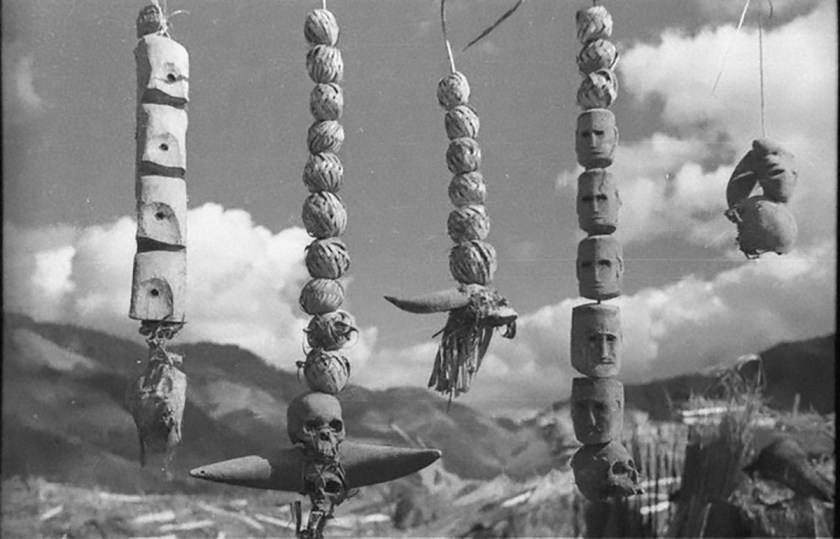
COVER IMAGE – Chingmei, Nagaland, Tuensang district, India 1936 (chang naga)

 ROAD TO NARA
I guess the moral to this story is that everything is vulnerable to something. I enjoyed reading it.
LikeLiked by 3 people
Thank you Tippy, i guess the true meaning pf this story which is prevalent in different regions in different forms is that people with low Nature are never grateful for anyone’s favours and reveal their true colours.
LikeLiked by 1 person
Pingback: The Greatest Man in the World | Ned Hamson's Second Line View of the News
Thanks Ned
LikeLike
Compliments on the story. Above all it shows the wisdom of of our forefathers anywhere. And those stories would be shared by the campfire. And everybody would click their tongue and say achcha or whatever the correct word was then.
As an aside, this made me think of Levi-Strauss, a French anthropologist who studied original myths and stories in the Americas, myths no doubt carried along when people crossed Bering from Asia about 10,000+ years. He concluded after an exhaustive study of hundreds of myths and stories, that all boiled down to a handful of stories, maybe 2 or 3… He specialised in Latin America, but I wonder if he’d compared those to the Mahabarata whether he would found similarities.
Take good care of yourself.
Phir milenge.
🙏🏻
LikeLiked by 4 people
Loved reading and re-reading your comment bablu ji. Its always encouraging and entertaining to have your words and vibe here.
Levi Strauss could be right about it in the Americas but you are right too, he might not have compared or dug enough parallels with the epic Mahabharata.
Thanks for this beautiful communicative comment
Phir milenge 🙏🌸
LikeLiked by 1 person
🙏🏻
LikeLike
Folktales are always interesting and offer food for thought. Lovely pictures.
LikeLiked by 3 people
Thank you Caro. Yes images are of an old Naga landscape. I like them too.
LikeLike
A man sees a beautiful girl, probably meaning a woman not a child, so let’s call her what she is, a woman. A man sees a beautiful woman, and his first thought is that he could benefit from giving her away. As if she is his to give away. As if it’s appropriate to give away another person. As if she has no agency as a human being. So I question who is truly the rat here.
Alison
LikeLiked by 3 people
You are absolutely right dear Alison. And coming to think of it no one has the right to give away a person away, and as i learn now and even commented above about this story inhabiting different regions in different forms. I appreciate you writing it as it is. Thank you much.
Also hoping you and Don are happier and healthier. I was away and couldn’t keep up with your posts. I will catch up soon.
LikeLiked by 1 person
Don and I are both well! We are enjoying life and each other. I hope you are well too dear Narayan.
You may not be aware of it but the domain name has expired on your blog so it is no longer publicly available. I hope you will be able to fix this.
Wishing you much happiness
Alison
LikeLike
A beautiful folktale, Narayan ji. What I feel is that the concept of the greatest man in the world is subjective and can vary depending on personal perspectives and cultural context.
LikeLiked by 2 people
Thank you Kaushal ji, hope you are doing well. You are absolutely right. It is subjective, like this tale i learn now inhabits different regions in different forms.
LikeLiked by 2 people
You’re welcome, always!
LikeLike
Nice story!
LikeLiked by 2 people
Thank you, Harini.
LikeLiked by 2 people
I think this story is also there in the Sanskrit either in Panchatantra or Hitopadesha with the title :
पुनर्मूषको भव!
somewhat changed.
LikeLiked by 1 person
Very much possible Vinay ji. As you know all folks were travelling and must have kept taking their own taste and form like water and region.
But, does पुनर्मूषको भव! mean ‘becoming the rat again’?
LikeLiked by 1 person
As a matter of fact, this story was there with this precise title :
पुनर्मूषको भव!
in our Sanskrit Text book.
This was about a Rishi who lived in a jungle and one day while he was going through the jungle a mice fell from the claws of a hawk upon him. He took the poor mice to home and sprinkled water upon her and Lo! It turned into a very beautiful little girl! She was taken care of and reared up by the Rishi as his own daughter. When she became a youth the Rishi thought of marrying her with a right match. So he asked her :
What kind of a spouse you would like to be married to?
She replied : The most Powerful one on earth!
Then the Rishi Looks for such a powerful one and as is the end in your story, he finds a mouse who could dig holes in the mountains. The daughter liked the rat mouse, and agreed. The Rishi then again sprinkles waters with chanting a mantra and the girl turns into a mice. The Rishi heaved a sigh of relief and the couple lives happily ever after!!
So the words “पुनर्मूषको भव” became a famous Sanskrit proverb phrase in Sanskrit.
**
LikeLiked by 1 person
It’s exact and truly represents Panchatantra legacy. I ll remember these words from.here onwards ‘punarmushakko bhav’. Pranam.
LikeLiked by 1 person
🙏🌹🙏
LikeLike
thanks for visiting my site. I would be thrilled if you’d write a guest blog post for my site. If you think it might be fun or helpful to have my followers (who total about 10k across my various social media) meet you, here’s the link for general guidelines:
LikeLiked by 2 people
Thanks Da, it is very generous of you to ask me to write as a Guest writer. Why not. Let me write back to you in January on this. Thank you.
LikeLiked by 2 people
Wonderful! Whenever you’re ready or if you have questions please email me at contactdaal@gmail.com
LikeLiked by 1 person
The second reading, Narayan, reads even better! Brilliant!
Joanna
LikeLiked by 4 people
Thank you, dear Joanna.
LikeLiked by 1 person
You are welcome, Narayan.
Joanna
LikeLiked by 1 person
great post
LikeLike
Thank you
LikeLike
Such a humbling story. Every being that is created by God is great.
LikeLiked by 2 people
Absolutely, each being and everything here and around us are an inseparable part of us. Thank you. And apologies for taking this long a time to write.
LikeLike